Build a SOAR analysis slide in PowerPoint where Aspirations and Results carry a real future state and a number — not the generic lines a copied SWOT template leaves behind.
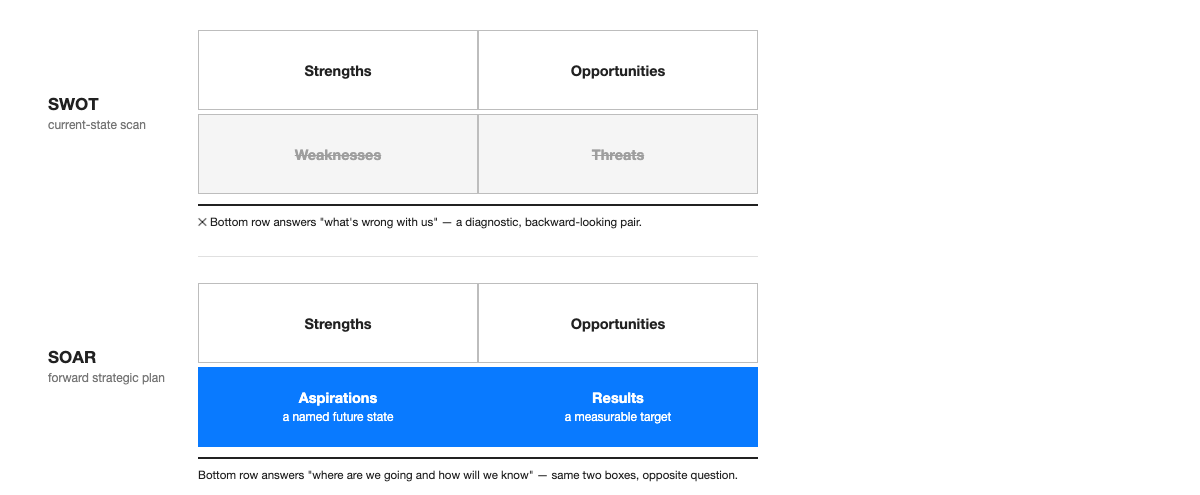
SOAR analysis was formalized in 2003 by Jacqueline Stavros, David Cooperrider, and Lynn Kelley, built directly on the Appreciative Inquiry research Cooperrider had published with Suresh Srivastva in 1987 — work that found deficit-based planning sessions (the kind SWOT runs on) tend to leave a room diagnosing problems rather than committing to a direction. A SOAR slide keeps SWOT's Strengths and Opportunities boxes, then replaces Weaknesses and Threats with Aspirations (a named future state) and Results (how you'll know you got there). The layout is a simple 2x2. What breaks almost every SOAR slide is the bottom row: teams fill Strengths and Opportunities with specific evidence, then write Aspirations as "be the market leader" and Results as "grow revenue" — language so generic it would survive being copy-pasted into any other company's deck unchanged. Fix that, and the rest of the slide follows.
Why SOAR Swaps Out Weaknesses and Threats, Not Just Renames Them
It's tempting to treat SOAR as SWOT with nicer words on the bottom row — Aspirations as a softened Weaknesses, Results as a friendlier Threats. That reading misses what actually changed. SWOT's four boxes all answer the same underlying question, "where do things stand right now," from four angles: what we're good at, what's open to us, what's broken, what could hurt us. SOAR's bottom row asks a different kind of question entirely — not "where do things stand" but "where are we trying to get, and how will we prove we arrived." Aspirations and Results are forward-facing and outcome-facing in a way no amount of positive rewording turns Weaknesses and Threats into. That's also why SOAR keeps Strengths and Opportunities rather than inventing new top-row boxes: those two were never the diagnostic half of SWOT to begin with — they describe existing assets and openings, which is exactly the raw material a forward plan needs to build from.
The practical consequence for a slide: Strengths and Opportunities boxes transfer over almost unchanged if a team already ran a SWOT, because the question each one answers hasn't moved. Aspirations and Results can't transfer over at all — there's no SWOT box to source them from, which is precisely why those two boxes are the ones every team gets stuck on.
On the finished slide, that split shows up as a 2x2 grid with Strengths and Opportunities on top, Aspirations and Results on the bottom, each box holding three to five short lines rather than full paragraphs. The top row reads like an audit: named capabilities, named external openings, each line traceable to something that's already true today. The bottom row reads like a commitment: one sentence naming a specific future state, paired with a short list of numbers that would prove the team got there. A reader scanning the slide top to bottom should feel the tone shift partway down — from "here's what we have" to "here's what we're committing to" — and if that shift isn't visible, the bottom row is probably still written in audit language borrowed from the top.
Step 1: Write Strengths as Named Evidence, Not Adjectives
Each Strengths line should name a specific capability, asset, or track record — not a quality. "Strong engineering team" is an adjective wearing a bullet point; "92% of enterprise renewals close without a discount request" is evidence. The test: could a competitor's slide carry the exact same line unchanged? If yes, it's not actually describing your organization's strength, it's describing a category of thing companies sometimes claim to have.
The 90-person SaaS company from Step 3 below ran into this on its own first draft: the engineering lead's opening line was "Strong, experienced product and engineering team." Pulled against actual numbers, the real claim turned out to be narrower and more useful: "Platform team has shipped every major release on the published roadmap date for six straight quarters, with zero rollback incidents." The second version survives a skeptical read in the room; the first one invites the question "compared to what," which is usually the sign a Strengths line hasn't been checked against data yet.
Common mistake: writing Strengths from a brainstorm rather than from data already sitting in the business — renewal rates, NPS by segment, win rates against named competitors, retention by cohort. A SOAR workshop that starts with "what do we think we're good at" produces adjectives; one that starts with "pull the three numbers that back up each claim" produces evidence.
Step 2: Turn Opportunities Into Named Openings, Not Market Categories
The same specificity test applies to Opportunities, with a different failure mode. "Growing market for our product" is a category, not an opening — it describes an industry trend that exists whether or not your organization does anything about it. "Three of our top-12 accounts asked about a mid-market tier we don't currently sell" is an opening: it's specific to your organization, time-bound, and actionable by the team in the room. Market-size statistics belong in a market-sizing slide elsewhere in the deck, not in the Opportunities box of a SOAR analysis, which exists to capture what's open to this organization specifically, not what's true of the category in general.
The same SaaS leadership team's first-draft Opportunities line read "Large and growing market for healthcare ops software" — true, and useless, since it would have been equally true for every competitor's own SOAR slide. Rewritten against what the sales team actually knew going into the offsite, it became "Three of our top-12 accounts have independently asked whether a mid-market tier exists, and two named a specific spreadsheet-based competitor they're trying to replace." That line does what an Opportunities line is supposed to do: it's specific to this company's pipeline, it's time-bound to right now, and it's the exact piece of evidence the team used, one step later, to write the Aspirations sentence in Step 3.
Common mistake: importing Opportunities straight from an old SWOT without checking whether they're still live. A SOAR workshop run a year after the last SWOT often carries forward an opportunity that's already been captured, missed, or closed off by a competitor — stale Opportunities quietly undercut the forward-looking tone the bottom row is trying to establish.
Step 3: Make Aspirations a Single Sentence Naming a Future State
This is the box almost every SOAR slide gets wrong, and the fix is narrower than it looks: one sentence, naming a specific future state, with enough detail that two different readers would describe the same destination. A 90-person SaaS company running a three-year strategy offsite is a useful case because the failure and the fix both showed up in the same room. The leadership team's first-draft Aspirations line read: "Be the leading platform in our category." It's not wrong, exactly — it's just true of every company in the room's category of slide, interchangeable with what a dozen competitors would write under the same header, and it gives nobody downstream anything to build a plan against.
The team reworked it against one constraint: name the category position precisely enough that achieving it and not achieving it would look visibly different from the outside. The revision: "Become the default platform mid-market healthcare ops teams switch to from spreadsheets, not the alternative they compare against an incumbent." That's still one sentence. It names a specific buyer segment (mid-market healthcare ops), a specific competitive position (default switch-to choice from spreadsheets, not a feature-compared alternative to an incumbent), and a claim specific enough that it's falsifiable — a reader could later look at the business and say plainly whether it happened.
Common mistake: writing Aspirations as a mission-statement sentence that would sound equally at home on the company's About page. A mission statement is meant to be stable for a decade and true of the company at any moment; an Aspirations line is meant to describe a specific future state this particular strategic planning cycle is aimed at. If the sentence would have worked unchanged five years ago, it's not naming where this plan is actually headed.
Step 4: Attach a Measurable Target to Results — Or Leave the Box Empty
Results exists to answer one question: how will the team know, concretely, that the Aspiration got real. Each line needs a metric, a baseline, a target, and a date — all four, not a subset. The same SaaS company's first-draft Results line read "Grow revenue significantly," which fails every part of that test at once: no named metric, no baseline, no target, no date. Reworked against the Aspiration above, it became three lines: "Net revenue retention: 94% to 108% within 18 months. Mid-market healthcare logos: 40 to 140 within 24 months. Spreadsheet-displacement win rate in competitive deals: 22% to 45% within 18 months." Each line traces back to the specific Aspiration sentence — a reader can check whether the team is tracking toward the future state it named, not just whether revenue went up for some unrelated reason.
If a team genuinely can't attach a baseline and a target to a Results line yet — the data doesn't exist, or the metric hasn't been defined — the honest move is to leave that line off the slide rather than fill the space with a vague placeholder. A Results box with two sharp, verifiable lines is more useful to a steering committee than one with five soft ones, and an empty line is a visible flag that the measurement work still needs to happen before the plan can be tracked.
Common mistake: writing a Results line as an activity instead of an outcome — "launch the mid-market tier" instead of "mid-market logos: 40 to 140." Launching the tier is a project milestone, not proof the Aspiration happened; a team can launch a product and still fail to win the category position it named.
Step 5: Build the Grid in PowerPoint
Lay the four boxes out as an even 2x2 with equal width and height — this is a framework where all four boxes carry comparable strategic weight, so resizing them to fit however much text got written undercuts the slide the same way it would on a 4Ps marketing mix grid. Keep Strengths and Opportunities in a neutral fill (white or light gray) and set Aspirations and Results apart with the deck's one accent color, so the tone shift from "audit" to "commitment" reads visually before anyone reads a single line. Use a short header label inside each box (STRENGTHS, OPPORTUNITIES, ASPIRATIONS, RESULTS) in matching type size and weight across all four, and cap each box at three to five lines — a Results box that needs eight lines to say what it means usually has targets that haven't been prioritized yet. Advisio, listed on Microsoft AppSource, builds this grid as four equal native PowerPoint shapes with the accent-color split built in, so the visual distinction between the audit row and the commitment row doesn't depend on someone remembering to apply it by hand.
When to Run SOAR After SWOT, Not Instead of It
SOAR isn't a strictly better SWOT — it's built for a different moment in a planning process, and the two frameworks compose well in sequence rather than competing for the same slide. SWOT is a situational scan: it's the right tool when a team needs to surface risk before a market entry, a compliance review, or an M&A decision, and intentionally naming weaknesses and threats is the point, not a flaw to route around. SOAR is a planning and alignment tool: it's the right move once the situational scan is done and the team needs to commit a room to a direction and a set of measurable commitments — vision-setting, culture change, or an early-stage strategy where the process of naming Aspirations out loud, together, is part of what the session is for.
| Axis | SWOT | SOAR |
|---|---|---|
| Core question | Where do things stand right now | Where are we headed, and how will we know |
| Best for | Risk review, due diligence, competitive analysis, market entry | Vision-setting, culture change, early-stage strategy, offsites |
| Process value | A data-collection exercise — the output matters more than the session | A participatory conversation — naming Aspirations together is part of the point |
| Weak spot | No mechanism for turning findings into a committed direction | No mechanism for surfacing risk — a team can commit to a direction it hasn't stress-tested |
The sequence that avoids both weak spots: run SWOT first to surface what's broken and what could hurt the organization, resolve or consciously accept those risks, then run SOAR with the same room to turn "here's our situation" into "here's where we're going and how we'll measure it." Running SOAR without ever having done the SWOT work doesn't make the risks disappear — it just means nobody in the room named them before committing to a direction.
Three Common Mistakes to Check Before the Slide Ships
First, an Aspirations line written as a mission statement rather than a planning-cycle target — if the sentence would have been equally true five years ago, it's not describing where this specific plan is headed. Second, a Results line with no baseline or no date — a target number without a starting point and a deadline isn't a commitment, it's an aspiration wearing the Results box. Third, Strengths and Opportunities boxes carried over unchanged from an old PESTEL or SWOT exercise without checking whether they're still current — a strength that was true eighteen months ago and an opening a competitor has since closed both belong off the slide, not quietly inherited onto it. A SOAR slide that passes all three checks reads as a commitment a team actually intends to be held to, not a positive-sounding rewrite of whatever the last planning exercise already said.